
Somewhere around the 14th hole last September, my lower back made the decision for me. That familiar ache had been building since the turn, the one that settles low in my lumbar and just sits there no matter how I shift my weight, and I still had four holes and a push cart full of clubs ahead of me. I'm Gary Lindquist, 62, a retired shop teacher from Rochester, Minnesota. I've played this game for thirty years, usually twice a week from May through October. For the last ten of those years, my back has had a vote in every round I play. Some days it votes yes. Some days it votes no.
So when I decided to do something about it, the question wasn't which swing trainer builds the most impressive swing. It was which one a golfer with a cranky lower back can actually use without making things worse. I spent five weeks swinging the Orange Whip swing trainer and a plain weighted club side by side, in my garage and before rounds at the course. The honest answer is that they do different jobs. For my back, the Orange Whip wins. For raw strength and speed, the weighted club wins. Here's the breakdown, and I'll tell you where each one let me down.
How I Tested Both
First, the disclaimer, because I'm not a doctor or a physical therapist and I don't pretend to be one on the internet. If your back pain is sharp, or it radiates down a leg, or anything goes numb, put the phone down and go see a professional. My situation is specific: a stiff, achy lumbar that tightens up after long drives to the course, flares up after I hit a bucket of range balls, and generally makes the back nine a negotiation. No surgery, no diagnosis beyond 'you're 62 and you've swung a golf club a few hundred thousand times.'
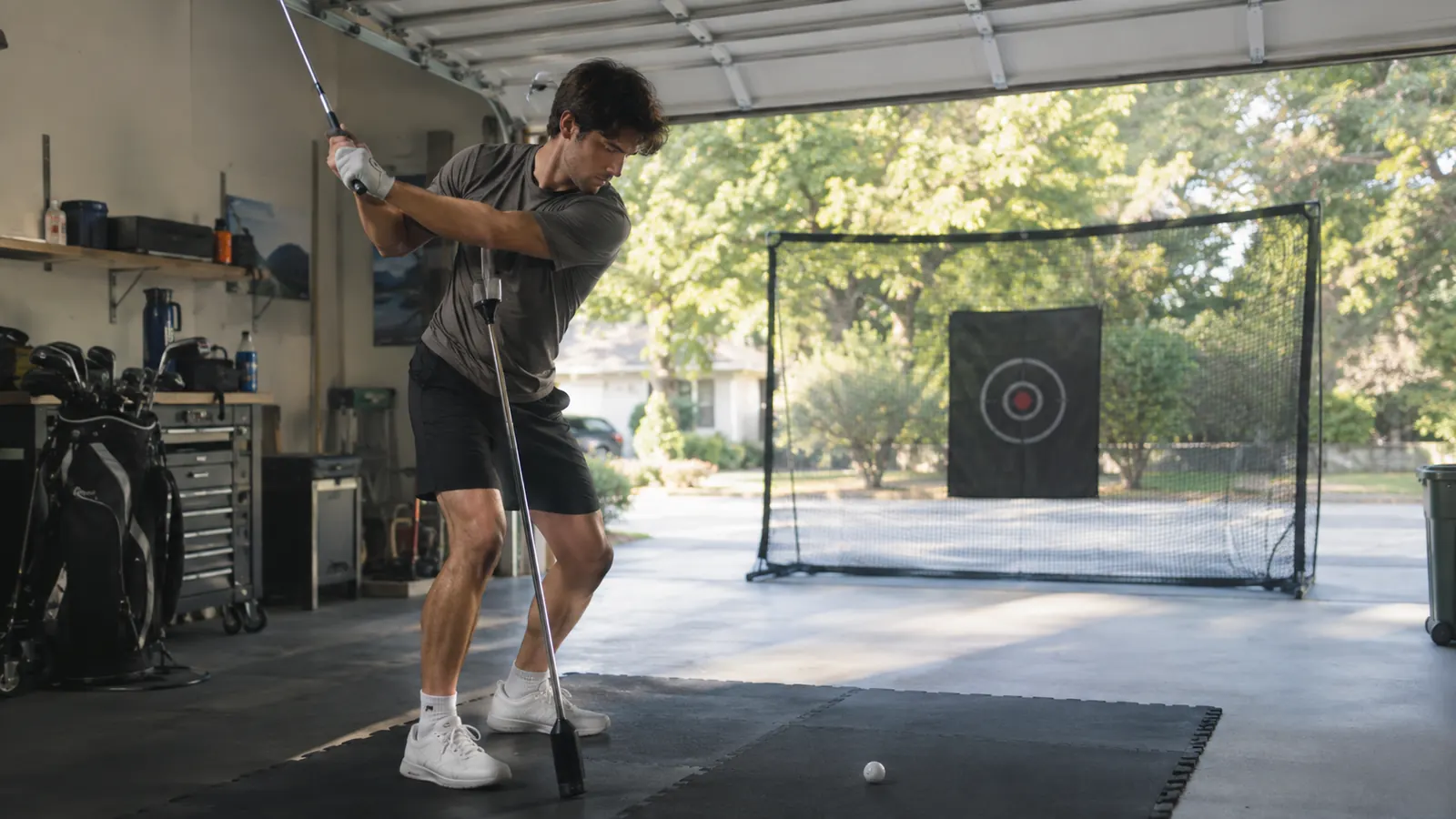
I tested both trainers over about five weeks, starting in late April. The Orange Whip got used almost every day: ten or fifteen slow swings in the garage on the foam mat in front of my hitting net, and a few more swings behind the first tee before a round. The weighted club I used two or three times a week, in shorter sessions, because it wears on me faster. Same warmup routine for both, same goal: work on tempo and stop rushing the transition from backswing to downswing, which is the flaw that gets me in trouble.
I kept a little spiral notebook, because at 62 my memory has a few gaps in it. After every session I wrote down three things: how my back felt before I started, how it felt during, and how it felt the next morning. I also noted how I swung on the first tee the next time out. It's not a lab test. It's just a guy paying attention, which is more than I used to do. Linda caught me writing in it one evening and asked if I was training for something. I told her I was training to get through eighteen holes without complaining. She laughed, which I think means she's heard that one before.
One more thing I should be honest about: I wanted the Orange Whip to win. I'd heard other golfers talk about it, and I liked the idea of a trainer that didn't feel like a punishment. But I tried to let the notebook decide, and the notebook was pretty clear. Here's what it said.
| Orange Whip | Weighted Club | |
|---|---|---|
| What it trains | Tempo, rhythm, and the full-body swing sequence | Muscle strength and raw swing speed |
| Load on the lower back | Flexible shaft loads gradually, never jars a stiff lumbar | Heavier head pulls hard and punishes an over-swing |
| Warmup before a round | Ten slow swings and my back loosens up | Wakes the muscles up, but easy to overdo |
| Strength and speed | Builds tempo, not muscle | Real resistance for off-season conditioning |
| Indoor use | Soft-flex shaft feels safe in a two-stall garage | Heavier and harder to control in tight quarters |
| Best for | Golfers with a cranky lower back who want their rhythm back | Healthy golfers building strength in the off-season |
Where Orange Whip Wins
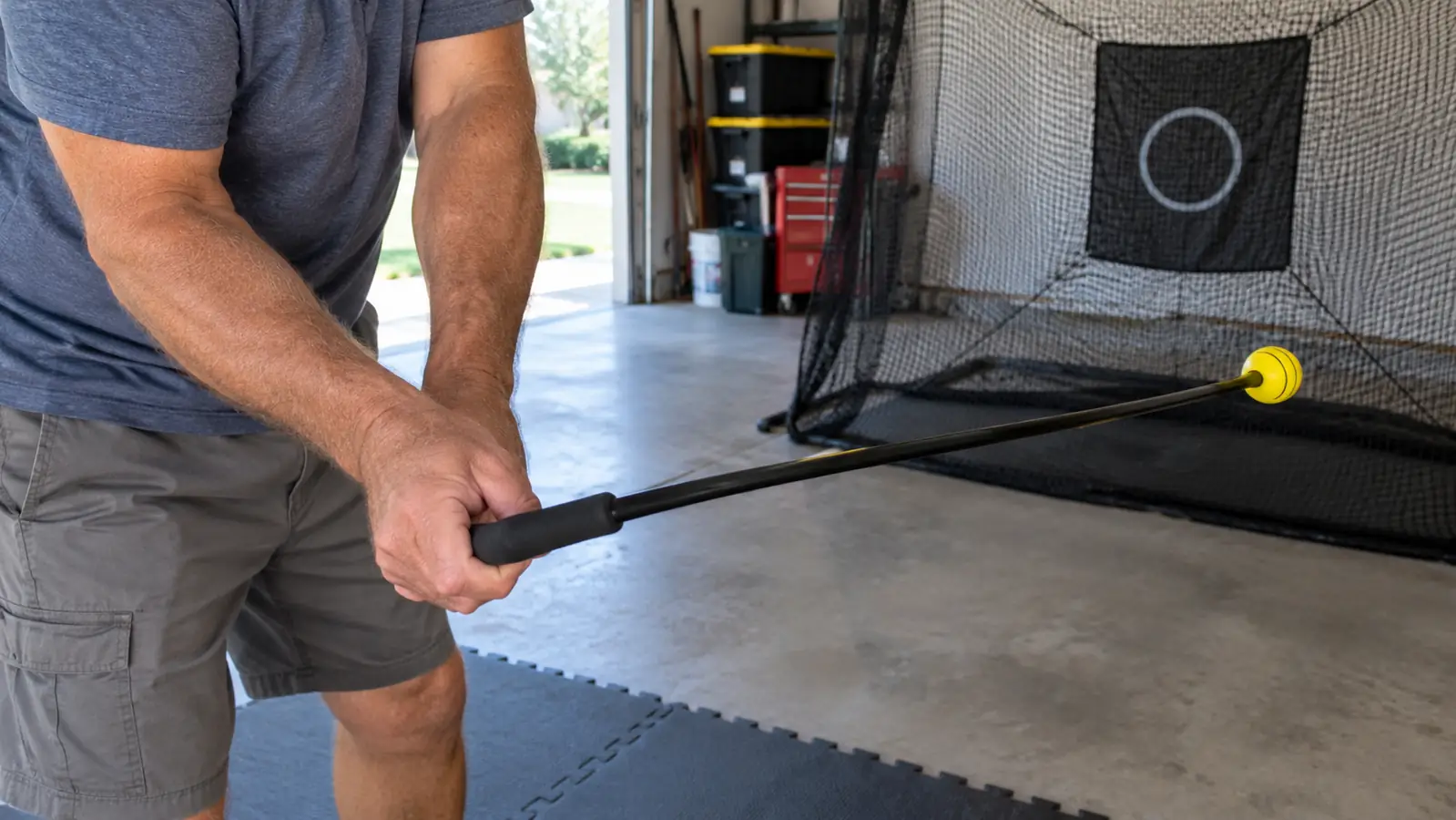
The biggest difference showed up in my back, and honestly, that's the whole reason this comparison exists. The Orange Whip has a flexible shaft, so when you swing it, the club loads and unloads like a slow fishing rod. The resistance builds gradually through the swing instead of hitting you all at once. For a guy with a stiff lumbar, that gradual load is everything. In five weeks, I never once finished an Orange Whip session with that sharp, 'I overdid it' twinge in my lower back. I can't say that about the weighted club, and I'll get to that in a minute.
The Orange Whip also fixed something I didn't expect, and it's the thing I actually needed fixed: my tempo. The flexible shaft punishes you if you rush the transition, because the club whips around and throws you off balance. You learn to let the swing happen instead of forcing it, because forcing it feels terrible. After a few weeks, that feeling carried over to real clubs. My swing got slower and smoother, and my back thanked me for it. The weighted club never taught me that, because with a rigid shaft, there's no feedback when you rush. You just muscle through it.
There's also a practical thing about the Orange Whip that matters for a guy like me: I can swing it in my garage without worrying. The flexible shaft means it doesn't have the same momentum as a heavy club, so I feel safe swinging it on the foam mat between the car and the workbench. I used it almost every day because it was easy to use every day. That consistency is what actually helped my back, more than any single session.
Where a Weighted Club Wins
I'm not going to pretend the weighted club doesn't have a place, because it does, and a real one. A weighted club builds strength. When you swing something heavier than a normal club, your muscles have to work harder, and over time that work shows up as clubhead speed. If your back is healthy and your goal is to add yards, a weighted club is the more direct tool for that job. The Orange Whip won't build muscle. It's a feel and tempo tool, and it's not trying to be anything else.
The weighted club is also simpler. It's a heavier version of a club you already know how to swing. There's no technique to learn, no tempo to feel, you just swing it. You can do proper strength-building drills with it, like slow-motion swings and holding the club at the top of the backswing, that don't work the same way with a whippy shaft. For a younger golfer with a healthy back, I'd point them to the weighted club first and tell them to have at it.
But here's the part I have to be honest about, because it's the whole point of this article. The weighted club is harder on my lower back. The heavier head pulls harder through the swing, and when I got tired, my form broke down, and when my form broke down, my lumbar let me know about it. Twice during the five weeks I had to stop a weighted club session early because my back was talking to me. That never happened with the Orange Whip. If you already have a cranky back, that's the difference that matters.
For a Golfer's Back, the Orange Whip Is the Safer Swing
Five weeks of swinging both, and the Orange Whip is the one that keeps my lower back happy and my tempo intact. If that sounds like your problem, it's worth a look.
Amazon Check Today's Price on Amazon →
Who Should Buy Which
Buy the Orange Whip if you're like me: a weekend golfer whose back tightens up on the back nine, who wants to warm up without flaring up, and who needs help with tempo more than strength. It's the trainer I reach for on a Tuesday morning when I'm stiff from yard work, and it's the one I swing behind the first tee. It fits the life of a 62-year-old golfer who walks with a push cart and just wants eighteen holes without negotiating with his own spine.
Buy a weighted club if your back is healthy and your swing is already smooth, and you want to add strength and speed. It's a good tool, and I don't want to talk you out of it if it fits you. But if you already own a weighted club and your back is telling you to slow down, that's your answer right there. Listen to it. I didn't for a long time, and I paid for it with rounds where I was just going through the motions.
One more thing worth saying: you don't have to choose forever. I still swing the weighted club occasionally, in short, careful sessions when my back feels good. But the Orange Whip is the one I use daily, because daily use is what actually changed how my back feels on the course. A trainer you use twice a month is a paperweight. A trainer you use every day is a fix.
The Orange Whip never gave me that sharp 'I overdid it' twinge in five weeks. The weighted club did, twice.
What Nobody Tells You About Swing Trainers
Nobody tells you that the hardest part of any swing trainer isn't the swinging, it's the showing up. The first week, both trainers felt great, because anything new feels great. The second week, the novelty wore off, and the weighted club started feeling like a chore. It was heavy, it was loud, and my back complained the next morning if I got ambitious. The Orange Whip never felt like a chore. It felt like stretching, like the good kind of warmup, and that's why I kept doing it.
Nobody tells you that a swing trainer can make you worse if you use it wrong. With the weighted club, I caught myself swinging harder to feel like I was getting a workout, and harder swings with a heavy club are exactly how you strain a lower back. The Orange Whip is harder to misuse, because the flexible shaft punishes tension. You can't muscle it. You have to stay smooth. For a guy whose default setting is to force things, that's a feature, not a bug.
The Bottom Line
If you force me to pick one for a golfer with a stiff lower back, I pick the Orange Whip without much hesitation. It's gentler, it teaches tempo, and it warms me up without wearing me down. The weighted club is a good tool for a different golfer, and I'd rather tell you the truth about that than pretend one trainer does everything. That kind of pretending is how people end up with a garage full of gear they don't use.
The best trainer is the one you'll actually use, and the one your back will let you use. For me, that's the Orange Whip. If you've been fighting a stiff lumbar and a rushed tempo, that's exactly the combination this thing was built for. And if you're not sure, that's what a return policy is for. See what it costs on Amazon today, and give it a few honest weeks. Your back will tell you the truth.
One last note: I bought mine with my own money, and I'm not getting paid to say any of this. I'm just a retired shop teacher who got tired of his back running the show. If the Orange Whip sounds like it fits your problem, try it. If the weighted club sounds like it fits yours, get that instead. The right answer is the one that keeps you swinging.
Give Your Back a Break and Your Tempo a Teacher
The Orange Whip is the swing trainer I keep coming back to, and the one my back lets me use every day. Check today's price on Amazon and decide for yourself.
Amazon Check Today's Price on Amazon →