
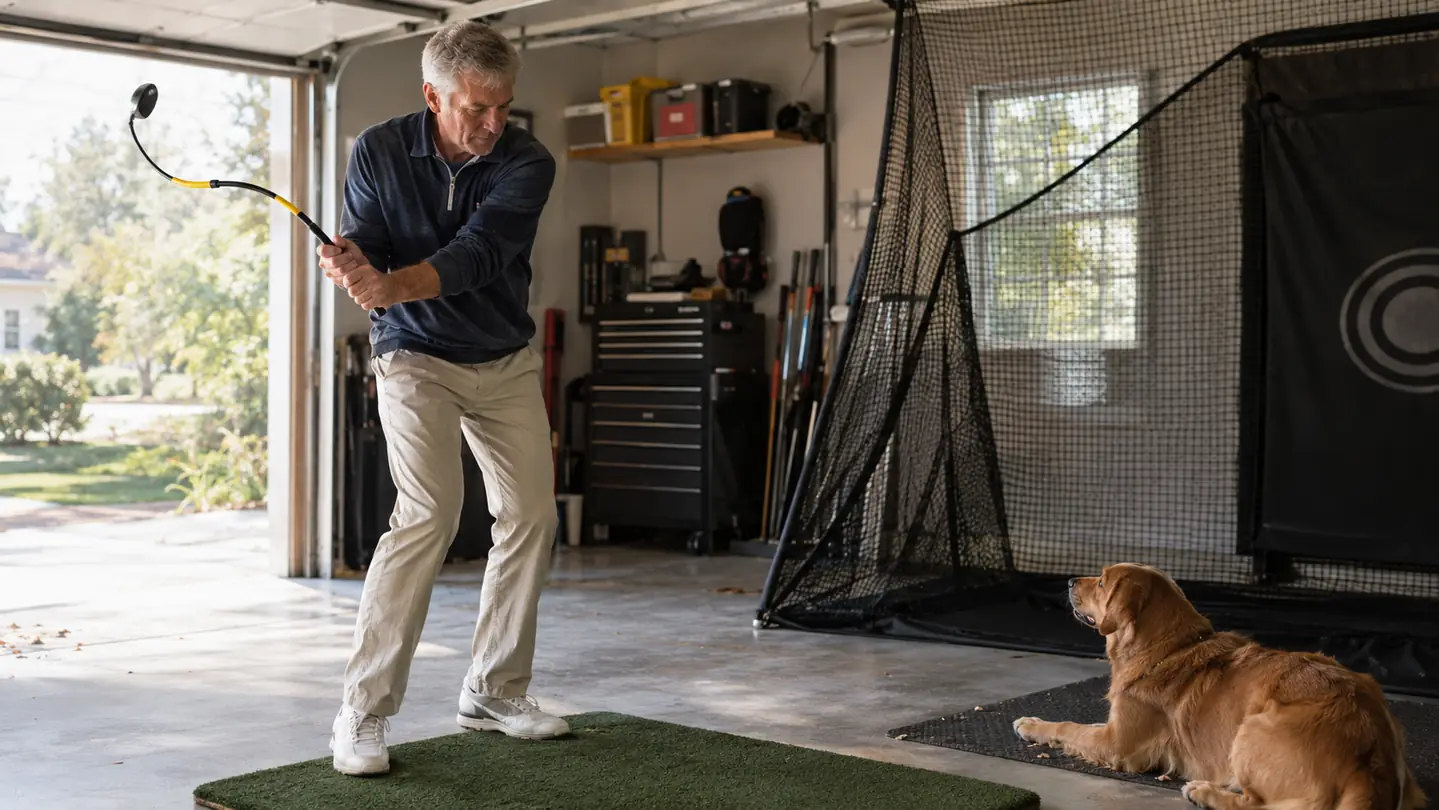
Somewhere around the 14th hole, my lower back starts talking to me. Not a sharp pain, nothing that would send me to the doctor, just a dull, grinding stiffness that makes the last few swings feel like I'm swinging in slow motion and makes the ride home a lesson in finding the least painful way to sit. I'm Gary, I'm 62, and I've played this game for thirty years. For the last ten, a cranky lumbar spine has been my most consistent playing partner. This past season I finally did something about it: I spent six months using the Orange Whip swing trainer before rounds, after rounds, and most mornings in my garage. This is what actually happened.
I'll be honest: I bought it skeptical. A flexible shaft with a weight on the end looked like every other gadget that promises to fix your swing and ends up in a garage sale by August. But after a full season from May through October, with a mid-teens handicap and a back that used to decide how I played the back nine, I have a clear picture of what this trainer does, what it doesn't, and who should buy one.
The Quick Verdict
The Orange Whip won't rebuild your swing overnight, but used daily it made my tempo smoother and my lower back noticeably quieter through a full season. It earned a permanent spot by my hitting net.
Amazon Check Today's Price →The training aid that took the strain off my back nine
I used the Orange Whip swing trainer through a full season, from the first frost-free morning to the last leaf on the fairway. Here's what changed, what didn't, and why it still leans against my garage wall.
Amazon Check Today's Price on Amazon →How I've Used It
The routine started small. I kept the Orange Whip leaning against the wall next to my bag, and most mornings I grabbed it while the coffee finished brewing. Twenty slow swings on the foam mat in front of the hitting net, then back on the wall. Twenty minutes later I wouldn't think about it again. That was the whole habit, and it was easy to keep because it never felt like practice.
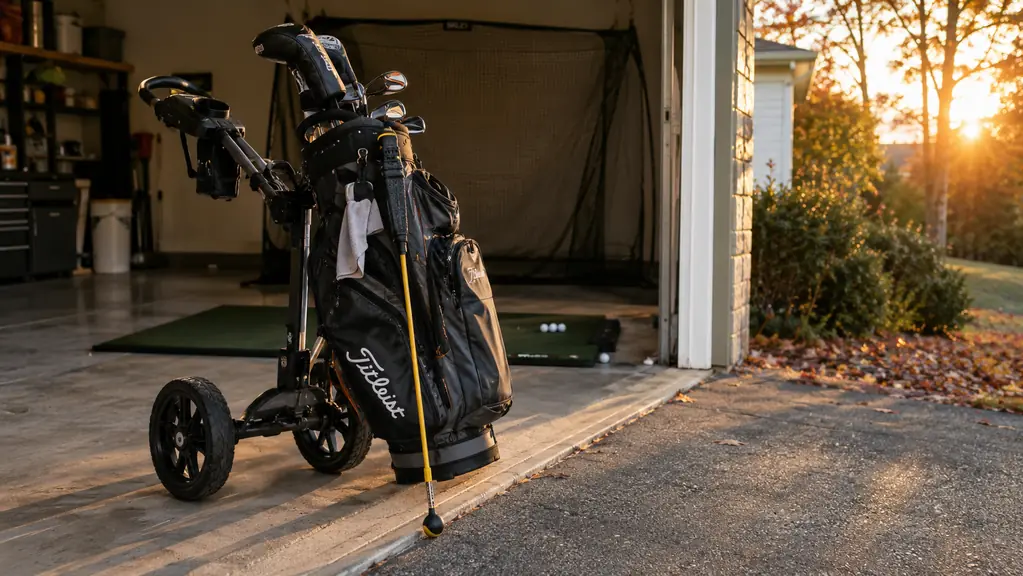
On golf days the trainer came along. Before a round I took it to the practice tee and made ten unhurried swings, the kind that start at half speed and build. After a round, especially if I'd walked all eighteen with the push cart, I made five more to unwind the lower back before the ride home. Linda, who walks nine holes with me some evenings, got used to seeing me swing a weighted stick in the driveway and stopped asking questions.
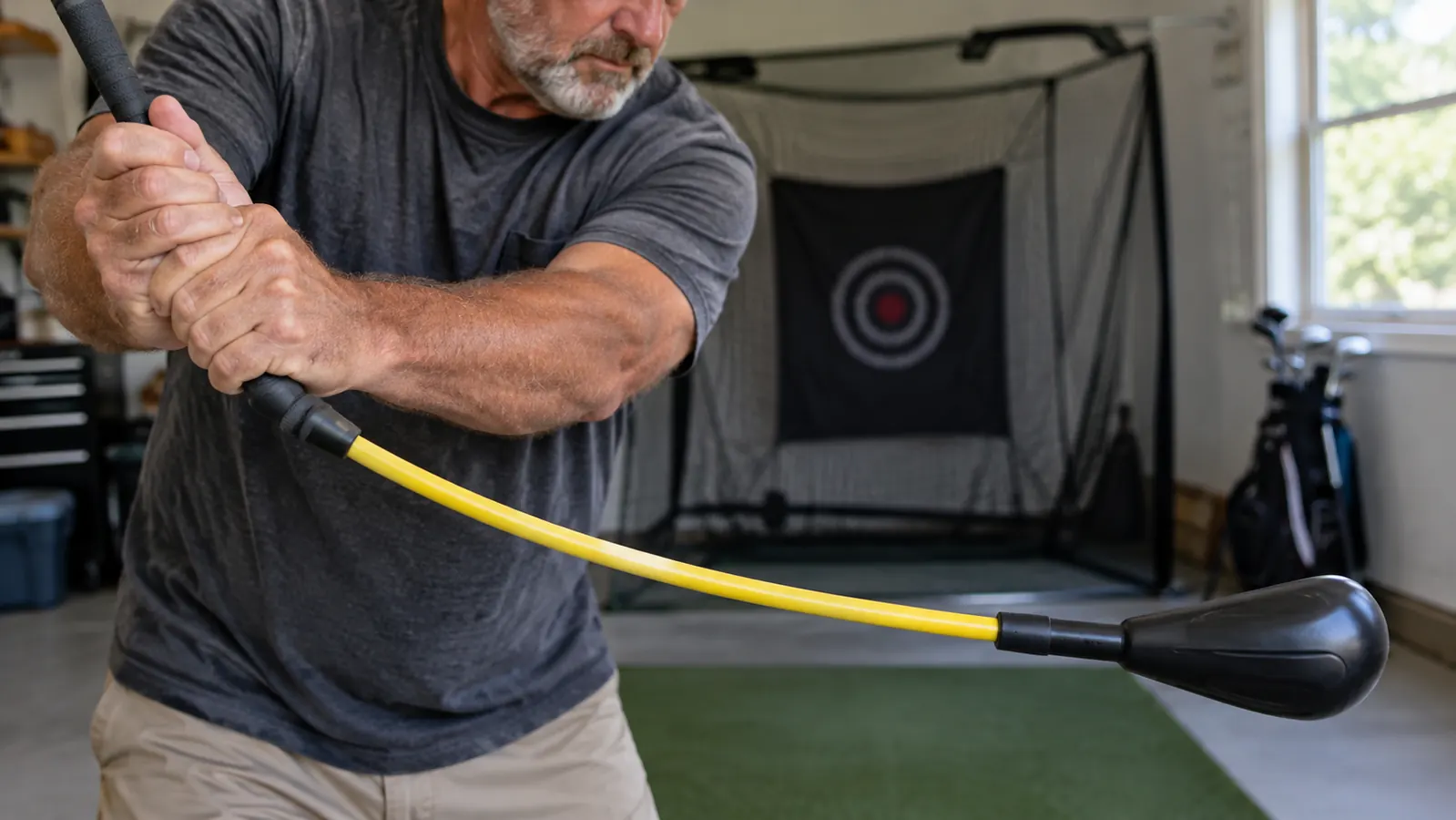
The first thing I noticed is how little it feels like a club. It's light, and the weight on the end changes everything about how you have to swing it. If you try to muscle it, the tip whips around and you feel the feedback instantly. If you let your hands lead, the same thing happens. The trainer rewards a smooth, connected turn and punishes a handsy, jerky transition, and it does both without you needing a coach to point it out.
It helped that the setup is forgiving. My garage is two stalls, and I keep a hitting net and a foam mat against the back wall. Birdie, our yellow Lab puppy, thinks the trainer is the best toy I've ever brought home. She watches the weighted tip swing past and sometimes tries to chase it, which means I've learned to check where she's lying before I take a swing. It's a small thing, but it made the routine feel like part of the house, not a project.
What the Orange Whip Actually Does
I'm not a swing coach and I'm not a physical therapist. I'm a retired shop teacher who has hit enough bad shots to know what help looks like. So here's what I can tell you from the user's end: the Orange Whip is built around a flexible shaft with a weighted tip. Swing it too fast and the tip lags behind, pulling your hands out of position. Swing it smoothly and the weight follows your turn, which is exactly the sequence you want in a real swing.
That feedback is the whole point. A normal club is so light and so forgiving of a rushed transition that you can make the same mistake a hundred times and never feel it. The Orange Whip makes the mistake obvious on the first swing. You feel when your body fires before your arms, and you feel when your arms outrun your body. My swing faults didn't disappear, but I finally knew what they felt like, and that turned out to be the first step to doing something about them.
It also does something useful on the course that I didn't expect: it works as a warmup that doesn't wear you out. Ten slow swings before a round got my back moving without burning the energy I needed for the first few holes. I used to try to loosen up by hitting a bucket of balls, which for me meant fifty swings and a tighter back. The trainer does the opposite.
One detail worth knowing: the grip is thicker than a normal club grip, and it took me a few sessions to get used to it. My hands are on the larger side from thirty years of shop work, so I liked it. A golfer with small hands might not. The trainer also asks you to hold it lightly. Grip it tight and the tension runs up your arms and into your shoulders, and you can feel the swing get stiff. Hold it loose and the weight does the work. That lesson, light hands, carried straight into my real swing.
The First Month: What Changed and What Didn't
For the first couple of weeks, nothing obvious happened. My scores didn't drop, my swing didn't magically smooth out, and my back felt about the same. I kept at it mostly because the routine was easy and I'm stubborn about things that cost money. Somewhere in week three, I caught myself doing something different on the course. On the 8th tee I made a slow practice swing before my real one, and it felt exactly like the swing I'd been making in the garage. Smooth, unhurried, connected. That feeling carried into the actual swing.
What didn't change is just as important. I still hit the occasional toe slice on bad days. I still rushed the transition when I was nervous on the first tee. The Orange Whip didn't fix my faults, and I don't think any trainer can. What it did was give me a clear picture of what a good swing felt like, so I could feel when I was doing it wrong. That sounds small, but it's the difference between guessing and knowing.
Mid-Season: Where It Earned Its Keep
The real test came in July, on the kind of hot, humid day where my back used to lock up by the 12th hole. I'd been doing the morning routine for about ten weeks. I walked the front nine with the push cart, and somewhere on the back nine I realized I wasn't thinking about my back. That had never happened before. Not once in ten years. I can't prove the trainer is the reason. Maybe it was the warm summer, maybe it was luck, maybe it was the ten extra minutes of slow movement every morning. But it's the only thing I changed, and I'm old enough to trust a sample size of one when the evidence is that clear.
The range was the other test. Hitting range balls used to be the worst thing for my back. Twenty balls with the driver and I'd be done for the day, stiff by the time I got home. This season I kept the bucket to forty, took the Orange Whip out between groups, made five slow swings, and the usual tightness never showed up. I started carrying it to the range the way other guys carry a water bottle. It became part of the routine, not an extra chore.
The clearest memory from the season was a September evening round with Linda. She walks nine with me sometimes, and we got to the 8th tee as the sun dropped behind the trees. I made one of those slow practice swings out of habit, then hit a tee ball that started down the left side and drew back to the middle of the fairway. Linda said, 'That looked easy.' It felt easy, and easy is not a word I use often for my golf swing. I don't think the Orange Whip deserves all the credit, but it deserves some.
The Tradeoffs Nobody Puts in the Product Description
First, you can't hit balls with it. It's a feel trainer, not a practice club. If you're the kind of golfer who only improves by hitting two hundred balls a week, this won't replace that, and it isn't trying to. It's a different job, and the sooner you understand that, the less disappointed you'll be.
Second, it needs room. The shaft is long and the weighted tip moves through a wide arc. My garage ceiling is standard height and I nearly clipped it the first few sessions. If you plan to use it indoors, measure your space and take a few cautious swings before you commit.
Third, it's a feel aid, not a mechanics fix. If your swing is broken in a way you can't feel, a trainer that works through feel won't be enough. You'll want a lesson with someone who can see what you're doing. And if your back problem is sharp, radiating, or numb, skip the training aids entirely and see a doctor or physical therapist. I'm not one, and nothing in this review is medical advice.
Alternatives I Considered
I tried a friend's weighted club before I bought the Orange Whip. A weighted club builds arm strength, but it didn't teach my body anything about sequencing. The flexible shaft is the difference. It gives you feedback you can feel on every swing, and that feedback is what changed my tempo. If you're choosing between the two, that's the question to ask: do you want to get stronger, or do you want to feel your swing in a different order?
I spent part of the season going back and forth between the Orange Whip and a weighted club, and the full comparison is worth reading if you're facing the same choice. The short version: the weighted club made my arms tired, and the Orange Whip made my swing smoother. One builds strength, the other builds sequence. They're not the same tool, and knowing which one you need is half the decision.
I also thought about just stretching more, and I still stretch. The trainer isn't a replacement for that. Stretching loosens me up; the Orange Whip teaches my body a smoother sequence while it's loose. They do different jobs, and I ended up keeping both.
What I Liked
- Smooth, unhurried swings reward you with instant feedback you can feel
- Light enough to swing indoors in a standard garage with a foam mat
- Works as a pre-round warmup that loosens the back without wearing you out
- Simple routine with no setup, no batteries, no app, no learning curve
- After a full season, my lower back stayed quieter on the back nine
Where It Falls Short
- You can't hit balls with it, so it won't fix a fault you can't feel
- The long shaft and weighted tip need ceiling clearance indoors
- It's a feel aid, not a swing mechanic; a lesson is still the real fix for a broken swing
- It does nothing for strength, so a back problem that is a strength problem needs a professional
Somewhere on the back nine I realized I wasn't thinking about my back. That had never happened before, and it's the whole review in one sentence.
Who This Is For
If you're a weekend golfer like me, mid-teens handicap, playing twice a week from May through October, and your back starts talking to you on the 14th hole, the Orange Whip is worth a look. It's also for golfers whose tempo falls apart under pressure, who rush the transition, who swing with their hands instead of their body. If you've ever made a practice swing that felt perfect and then couldn't repeat it with a ball in front of you, this trainer is for you. It builds a feel you can carry from the garage to the first tee.
Who Should Skip It
If you're a single-digit player who knows exactly what your swing does wrong and needs a mechanical fix, spend the money on a lesson instead. If you're looking for a way to hit more balls indoors, buy a net and a practice club. And if your back pain is sharp, radiating, or numb, don't buy any training aid until you've seen a doctor or physical therapist. The Orange Whip helped my specific problem, a stiff, achy lumbar spine that tightened up over eighteen holes. Your situation may be different, and that's not something a swing trainer can diagnose.
Bottom line: I'm going into next season with the same routine. Ten minutes in the garage most mornings, ten slow swings on the practice tee before a round, five after. The Orange Whip didn't turn me into a different golfer. It made the golfer I already am a little smoother, and it made my back a lot quieter. For a 62-year-old weekend golfer who wants to keep playing for another ten years, that's a fair trade.
It stayed in my garage all season
If your back tightens on the back nine the way mine does, the Orange Whip is worth a try. It's the only change I made this season, and it's still leaning against my garage wall. Check today's price on Amazon and see if it fits your routine.
Amazon Check Today's Price on Amazon →