
The first sign is always the same. I climb out of the car after the twenty-minute drive to the course, and my lower back answers with that familiar tightness. Not a sharp pain. Just a stiff, achy reminder that I am sixty-two years old and I have been asking my lumbar spine to do things it stopped approving of years ago.
I have played golf about twice a week from May through October for the last thirty years, and for the last ten of those, that morning tightness has been my regular playing partner. It used to cost me the first three holes of every round. Then I started warming up with the Orange Whip swing trainer in the garage before I left, and the first three holes came back. This is the routine I have settled on, step by step. It is not a cure, and I am not a doctor or a physical therapist, so anything sharp, radiating, or numb is a reason to see a professional, not a reason to swing harder. But for plain, cranky stiffness, this routine has gotten me through more rounds than I can count. Linda has started teasing me about it, but she is the first one to ask where the trainer is when her own back tightens up after she walks nine holes with me in the evening.
The trainer I reach for before every round
The Orange Whip swing trainer is the one piece of gear in my garage I refuse to skip. It loosens the back, warms up the swing, and rides in the trunk for the course. Check today's price on Amazon.
Amazon Check Today's Price on Amazon →Step 1: Set Up Your Practice Spot So You Actually Use It
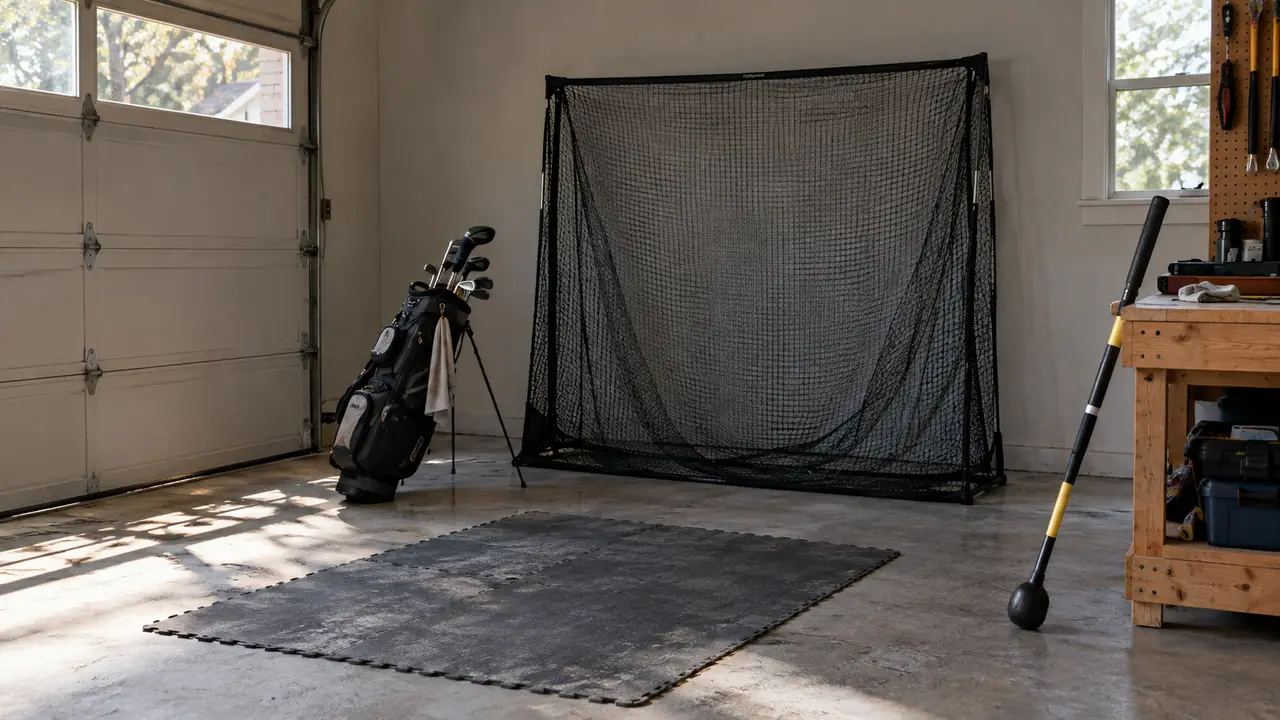
The hardest part of any warm-up is not the swinging. It is the walking out to the garage. I keep my hitting net in the corner of our two-stall garage with a foam mat in front of it, and I leave the Orange Whip leaning against the workbench where I cannot miss it. If the trainer is visible, I use it. If it is buried behind a snow shovel, I skip it, and I always regret skipping it. That lesson cost me a few rounds before it stuck.
You do not need a net for this routine. The Orange Whip is not a club, and you are not hitting balls with it. You need about the length of a parking space, a ceiling high enough to swing under, and something soft under your feet. My foam mat is three years old and has a worn spot in the middle. It still does the job. The point is to have a spot that takes thirty seconds to get ready, because a warm-up you have to assemble is a warm-up you will skip.
One more thing about the garage. Birdie, our yellow Lab puppy, has decided that this is where I do my most interesting work. She lies on the cold concrete and watches the whole routine with her head cocked. I cannot promise you will have a puppy supervising your warm-up. I can promise the whole thing takes less time than you think, and that is exactly why it survives.
Step 2: Start With Half Swings and Let the Weight Do the Work
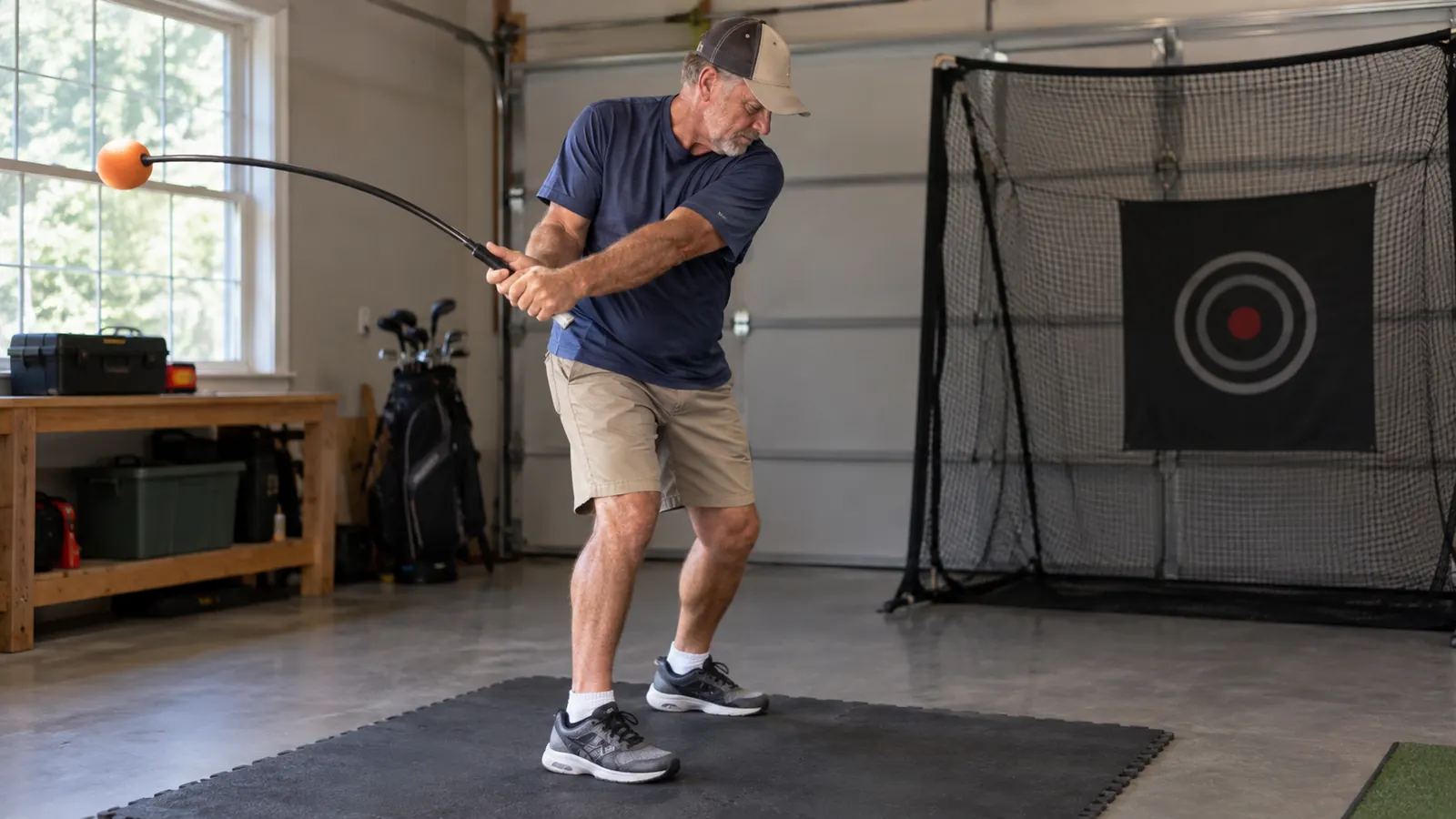
The Orange Whip has a weighted tip and a flexible shaft, and the first time you pick it up you will notice it wants to swing itself. That is the point. Do not grab it tight and force it. Hold it the way you would hold a club you actually trusted, take it back to about hip height, and let it fall through. The weight pulls the shaft, the shaft pulls your arms, and your lower back gets to move through a comfortable range instead of being yanked through a violent one. The flexible shaft is the part that matters most. It stores the energy and hands it back to you, which means your body learns a smooth rhythm instead of a jerky one.
I do ten of these half swings on each side before I take a full swing. The first few feel stiff, and that is fine. By the fifth one, the motion starts to smooth out on its own. Some mornings the fifth swing takes longer to arrive than others. I let it come when it comes. That is the feeling I am after: not a big stretch, not a workout, just the back remembering that it knows how to rotate. If anything feels sharp, I stop. Sharp is different from stiff, and sharp is a reason to see somebody.
A note on grip pressure. I used to squeeze the trainer like a garden hose, the same way I used to squeeze a golf club, and my forearms and back paid for it. The Orange Whip rewards a light grip. Hold it firmly enough that it does not fly out of your hands, then relax everything from the shoulders down. The trainer will show you the tempo you cannot find when you are gripping for dear life.
Step 3: Build Up to Full Swings at Tempo
Once the half swings feel smooth, I move to full swings. The goal here is rhythm, not power. I swing the Orange Whip the way I would like to swing a driver: smooth on the way back, a pause at the top, then a relaxed release through the bottom. The weighted tip makes a whoosh sound when the tempo is right, and I have learned to listen for it. No whoosh, no rhythm, and I start over.
I do ten full swings, then I put the trainer down and pick up a real club. This is the part that convinced me the routine was working. The first club always feels heavier than it should, because the Orange Whip is heavier than a normal club. Then the club feels light, because my back is warm and my swing is loose. I hit a few balls into the net, and the good ones come earlier than they used to. I have stopped counting how many rounds start with a good drive now. It used to be a coin flip. Now it is the usual thing.
How long does this take? About five minutes. I know because I have timed it, and because Linda will call from the kitchen to say the coffee is ready and I will still be out there swinging. Five minutes of deliberate motion beats twenty minutes of standing around stretching in the parking lot, and it beats the first three holes of stiffness that used to follow me around the course. The coffee can wait. The back cannot.

Step 4: Take It to the Course and Swing Between Shots
The Orange Whip is light enough to ride in my bag, and that is where the routine really pays off. My back does not just tighten in the morning. It tightens on the back nine, especially after long drives between holes or a wait on a crowded tee box. Now I take the trainer out on the tee box, make two or three easy swings while I wait, and step up to the ball already loose. I used to think a stiff back on the back nine was just part of getting older. It is not. It is part of letting the back go cold between swings.
I do the same thing in the parking lot before I check in. One or two swings next to the car looks odd to nobody, because every golfer within sight is doing some version of the same stretch. The difference is that the trainer gives my back a real range of motion to move through, not just a hamstring pull. Ten seconds of swinging beats ten minutes of sitting in the car hoping the stiffness works itself out.
One caution. Do not swing it on the cart path or anywhere near somebody else's backswing. I keep mine in the bag until it is my turn, and I step well off to the side. The trainer is long, and a golf course is full of people who are not watching where they walk. Common sense applies. The goal is a looser back, not a new story about how I got hit by a weighted whip.
Step 5: Cool Down Before You Drive Home
The drive home used to be worse than the drive to the course. I would play eighteen holes, sit in the car for twenty minutes, and arrive home stiff as a board. The fix turned out to be simple: a few slow swings before I put the trainer back in the trunk. Not a full routine. Just five or six easy swings to let the back know the work is done and it can relax now. It sounds small, but a few slow swings after the round is the difference between walking in the door loose and walking in the door stiff.
I also swing a few times after I get home, before I go inside. Birdie has learned that this is the signal that I am about to come in, and she waits at the garage door with a toy in her mouth. The whole cool-down takes two minutes, and it has done more for my evenings than any amount of sitting in a hot tub afterward. I still stretch a little before bed, but the back goes into the night loose instead of locked up.
If you play in the morning, do the cool-down before you drive anywhere. If you play in the evening, do it before you sit down for dinner. The timing matters less than the doing. A back that is warm when you finish is a back that will not punish you at 2 a.m. when you roll over.
What Else Helps
The Orange Whip is the centerpiece of my routine, but it is not the whole routine. I walk the course with a push cart when my back allows, because carrying a bag on one shoulder is a sure way to spend the back nine crooked. I also traded my old shoes for a pair with more support, and I stopped riding in carts on hilly courses. The less my back has to brace against uneven ground, the happier it is.
I am not a doctor, and I want to be clear about that. This routine is for the plain, achy stiffness that comes with age and a golf habit. If you feel anything sharp, anything that radiates down a leg, or anything numb, that is not a warm-up problem. That is a reason to see a professional before you swing anything, including a trainer. I have had my share of sore mornings, and I have never regretted being careful. That advice has saved me more rounds than any piece of equipment.
One more habit worth mentioning. I do a few gentle stretches the night before a round, and I drink water like it is my job on the day of. Dehydration makes every joint in my body complain louder. None of this is glamorous, but the combination of the trainer, the push cart, and basic common sense has kept me playing twice a week, and that is the only metric that matters to me. I stretch in the evening too, not just the morning. It all adds up.
Five minutes of deliberate motion beats the first three holes of stiffness that used to follow me around the course.
Start tomorrow morning in the garage
You do not need a net, a lesson, or a prescription. You need a trainer, five minutes, and a back that is tired of being stiff. The Orange Whip swing trainer is the one I use before every round. Check today's price on Amazon.
Amazon Check Today's Price on Amazon →