
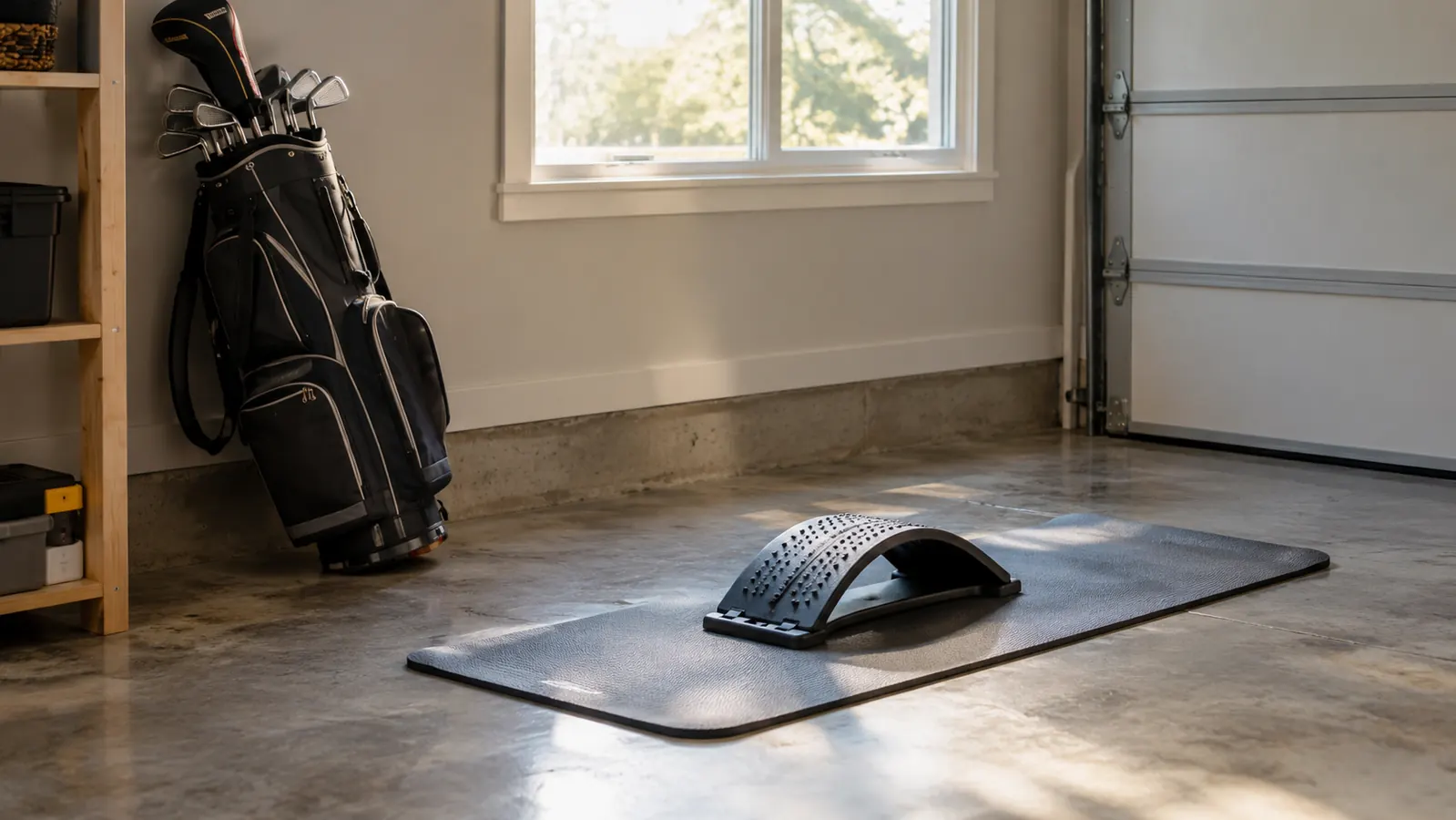
If you are a golfer over 50, you already know this story. The first few holes feel fine. You are loose, the swing feels long, and you think today might be the day the back behaves. Then somewhere around the 10th or 11th tee, the lower back starts to tighten. By the 14th you are swinging stiff, protecting the lumbar spine without meaning to, and the last four holes are about survival, not enjoyment. I have tried heating pads, ice packs, and a foam roller, and they all helped a little, but none of them fit into the twenty minutes between parking the car and teeing off. That was my pattern for years, and it is why I keep a MINOLL Back Stretcher on the foam mat in my garage.
I am Gary Lindquist, 62, a retired high school shop teacher in Rochester, Minnesota. I have played this game for thirty years, and for the last ten of them I have fought a stiff, achy lower back that tightens up after long drives to the course and on the back nine. It flares after I hit range balls, and it does not need a doctor's note to ruin a round. The garage has a hitting net in one corner and a foam mat in the other, so most of my golf life happens within ten feet of that mat. I am not a physical therapist, and I am not going to tell you that any device fixes a back by itself. What I can tell you is the routine I actually do in my garage before and after a round, and how the MINOLL Back Stretcher fits into it.
The Back Stretcher I Keep Next to the Golf Bag
It is a simple tool, not a cure. It helps me loosen a cranky lower back before I swing, and settle it down after the round. Check today's price on Amazon to see if it fits your routine.
Amazon Check Today's Price on Amazon →Why the Lower Back Gets Stiff on the Course
Golf is a lot of forward bending and rotation, repeated a few hundred times in an afternoon. The lumbar spine takes the load every time you hinge over the ball, and if the muscles around it are already tight from a long car ride or a desk chair, the hinge gets stiffer and the rotation gets shorter. A short swing is not a relaxed swing. When the back is tight, the body compensates, and compensation is where most of my bad shots come from.
The other piece is the drive. The course I play is twenty minutes from the house, which is long enough to sit in one position and let everything lock up. By the time I park the car, my lower back feels like it has been in a brace. Stretching before the round was always the obvious answer. The problem was that I never did it, because most of the stretches I knew needed a wall, a mat, or a partner. The MINOLL Back Stretcher changed that for me because it turned stretching into a ten-minute floor routine I can do in the garage without thinking about it.
The Five-Step Routine I Use
Here is the whole routine, the way I do it on a Saturday morning before I load the push cart. It takes about ten minutes. I do the same thing, in a shorter form, on evenings when I have been at the range.
Step 1: March in Place Before You Get on the Floor
I used to go straight from the car to the mat, and that was a mistake. A cold back on a hard floor is not ready to stretch. Now I spend two or three minutes just marching in place in the garage, lifting the knees to about hip height, swinging the arms a little. Nothing athletic. I am trying to get blood moving, not to break a sweat.
Then I do ten slow hip circles in each direction, hands on the hips, small circles, the kind of thing that looks silly if you watch it from the street. It loosens the hips, and loose hips take load off the lower back when I hinge over the ball. If Birdie, our yellow Lab puppy, is out in the garage with me, she treats this part as a game and tries to herd my feet. I let her. Bending down to play with her for a minute is its own kind of warm-up.
Step 2: Lie Down and Let the Lower Back Settle
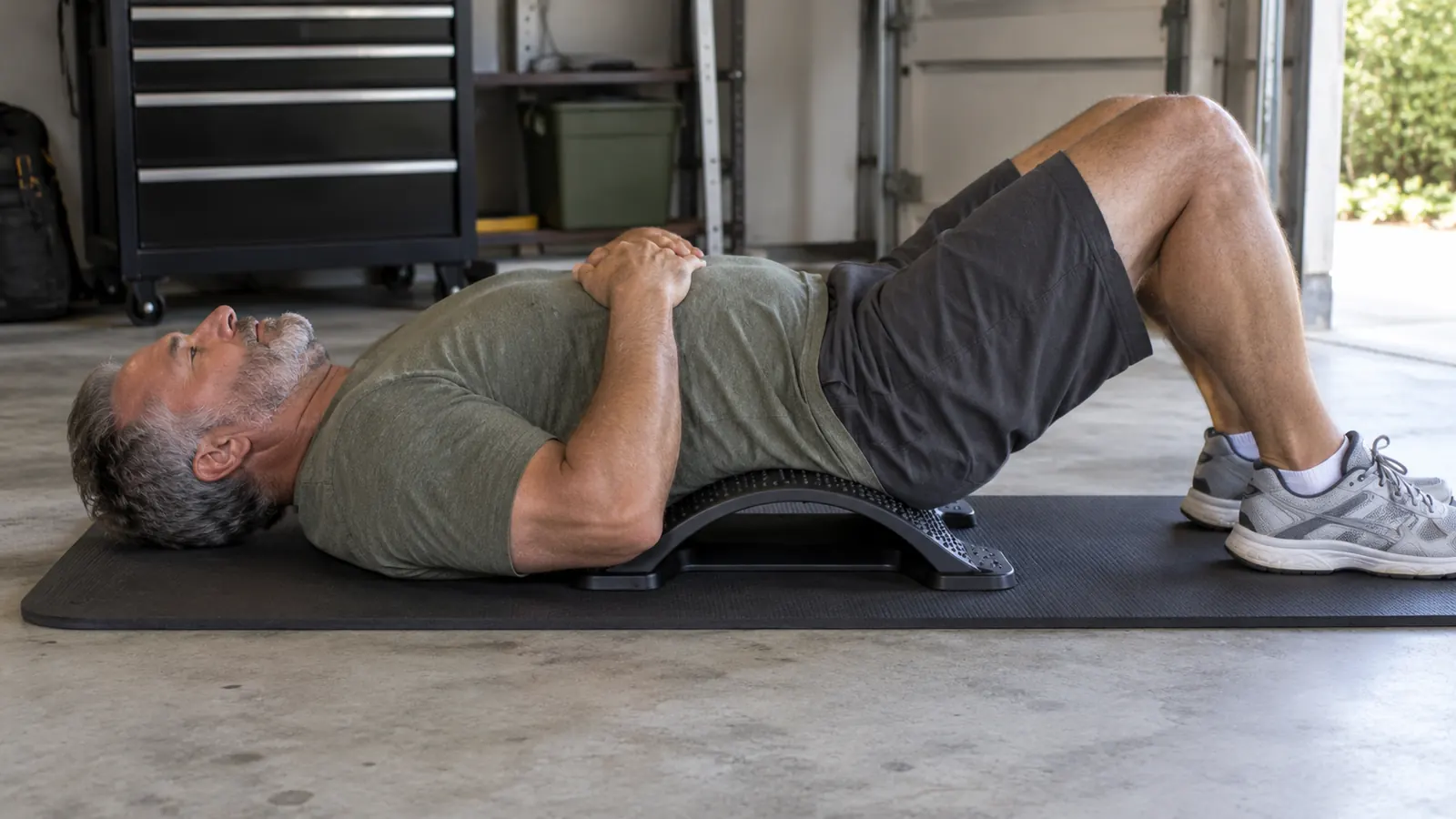
I keep a foam mat in the corner of the garage, and the MINOLL Back Stretcher lives on it. I lie down on my back, bend the knees so the feet are flat on the mat, and slide the stretcher under the lower back so it sits where the curve of the spine is. Then I just breathe. Slow breaths, in through the nose, out through the mouth, for about ninety seconds.
The first few times, the sensation was strange. The back is used to being held in whatever position it has been in all day, and letting the lower back settle against the stretcher takes a minute to feel normal. I do not force anything. I am not trying to make the back bend further. I am giving it permission to loosen, and most mornings it does, a little more with each breath.
Step 3: Work in Small Progressions, Not Big Bends
After the first minute, I shift the position slightly, moving the stretcher an inch or two so a different part of the spine gets the support. Then I add small movements: gentle side-to-side rocks, a slow roll of the pelvis, nothing that would qualify as a real bend. The idea is to convince the muscles around the lumbar spine that they can let go, not to force a bigger stretch out of them.
This is where I have to be honest about the limits of the tool. A back stretcher is not a substitute for a professional assessment. If something is sharp, radiating, or numb, that is a conversation for a doctor or a physical therapist, not a piece of equipment on a garage floor. For a dull, familiar tightness, the kind I have lived with for ten years, the slow progression works. I give it about four or five minutes total across steps two and three.
I also learned to stop the session the moment the back felt worse instead of better. There is a difference between a stretch that is working and one that is fighting back, and it took me a while to tell them apart. If the tightness eases, I keep going. If it does not, I get up, walk around the garage for a minute, and call it a day. Some mornings the back just wants to be left alone.
Step 4: Add Two Hip and Hamstring Moves
Golf back tightness is rarely just the back. Mine is tied to tight hamstrings and stiff hips, and if I skip this step, the lower back tightens again by the 15th hole. So after the stretcher work, I roll off the mat, get up, and do two simple moves: a seated hamstring stretch, one leg out, reaching toward the ankle, and a figure-four hip stretch lying on my back.
Each one gets two slow rounds of about thirty seconds per side. That is it. I am not flexible, and I am not trying to be. I am trying to arrive at the first tee with a back that bends and rotates the way it is supposed to, instead of one that has to be talked into it. If you want the longer version of how this all fits together, my full review of the MINOLL Back Stretcher covers the routine and how it has held up over a season of use.
Step 5: Repeat a Short Version After the Round
The routine before the round is the one that keeps the back nine playable. The routine after the round is the one that keeps Thursday walkable. When I get home, I do the same thing in a shorter form: two minutes of marching, three or four minutes on the stretcher, one round of each stretch. It takes less than ten minutes, and it stops the back from seizing up overnight.
The drive home is the part people forget. You finish the round, sit in the car for twenty minutes, and the back tightens in a whole new way. Doing the short version right after I park in the garage has made more difference to how I feel the next morning than anything else I have tried. On range days, I do the same short version when I get home, because range balls are what flare me up the most.
One note on timing: I do the after-round version even on days when I feel fine. The back does not usually announce that it is about to seize up. It just does, usually at 2 in the morning or when I try to pick up a golf bag the next day. The short routine is cheap insurance, and it takes less time than unloading the car.

What Else Helps
The stretcher is the center of my routine, but it is not the whole routine. The push cart was a bigger change than I expected. Carrying a bag on one shoulder loads the back unevenly, and switching to a push cart let me walk all 18 holes without the usual ache. I also warm up with a few slow swings in the garage hitting net before I ever get to the first tee, and I keep the practice swings short. A dozen good swings beat thirty sloppy ones.
Linda, my wife, walks nine holes with me some evenings, and those walks are the closest thing I have to a prescribed exercise. A twenty-minute walk on a course I am not playing keeps the back moving without the twisting. And if you are weighing this against the other option most golfers consider, I compared the MINOLL Back Stretcher against a foam roller in a separate piece, because I nearly bought the roller first and the tradeoffs matter more than you would think.
One habit I will not give up is the evening walk with Linda. Some of my best rounds have come after a slow nine holes the night before, and some of my worst have come after a day of doing nothing but sitting. Movement is the part of this that no stretcher can replace. The stretcher just makes the movement possible on days when the back would rather stay locked up.
One more thing: none of this replaces seeing a professional. I said it in the steps, and I will say it again here. If your back pain is sharp, radiating, or numb, stop reading and make an appointment. This routine is for the dull, familiar stiffness that most weekend golfers live with, and even then it took me about two weeks of daily use before I noticed a real difference. It is not a quick fix, and anyone who tells you otherwise is overselling it.
Three weeks in, I walked all 18 holes with the push cart and only felt the usual tightness, not the cramp that used to show up around the 14th tee.
The Bottom Line
Here is the honest version. The MINOLL Back Stretcher is not going to fix a bad swing, a weak core, or ten years of sitting. What it does is give you a simple, repeatable way to loosen the lower back before you ask it to do something demanding, and to settle it down afterward. For me, that has meant more playable back nines, fewer mornings where I wake up stiff, and a garage routine I actually stick with because it takes ten minutes and needs nothing besides the mat and the stretcher.
If you are deciding whether to try one, give it two weeks of daily use before you judge it. That is how long it took me to notice the difference. And if you want the reasons golfers keep one around, there is a separate piece with ten of them, including a few I did not expect when I bought mine.
Ten Minutes on the Garage Floor, Twice a Week
That is the whole commitment. The MINOLL Back Stretcher sits on the mat, ready when I am. Check today's price on Amazon and decide if it belongs in your routine too.
Amazon Check Today's Price on Amazon →