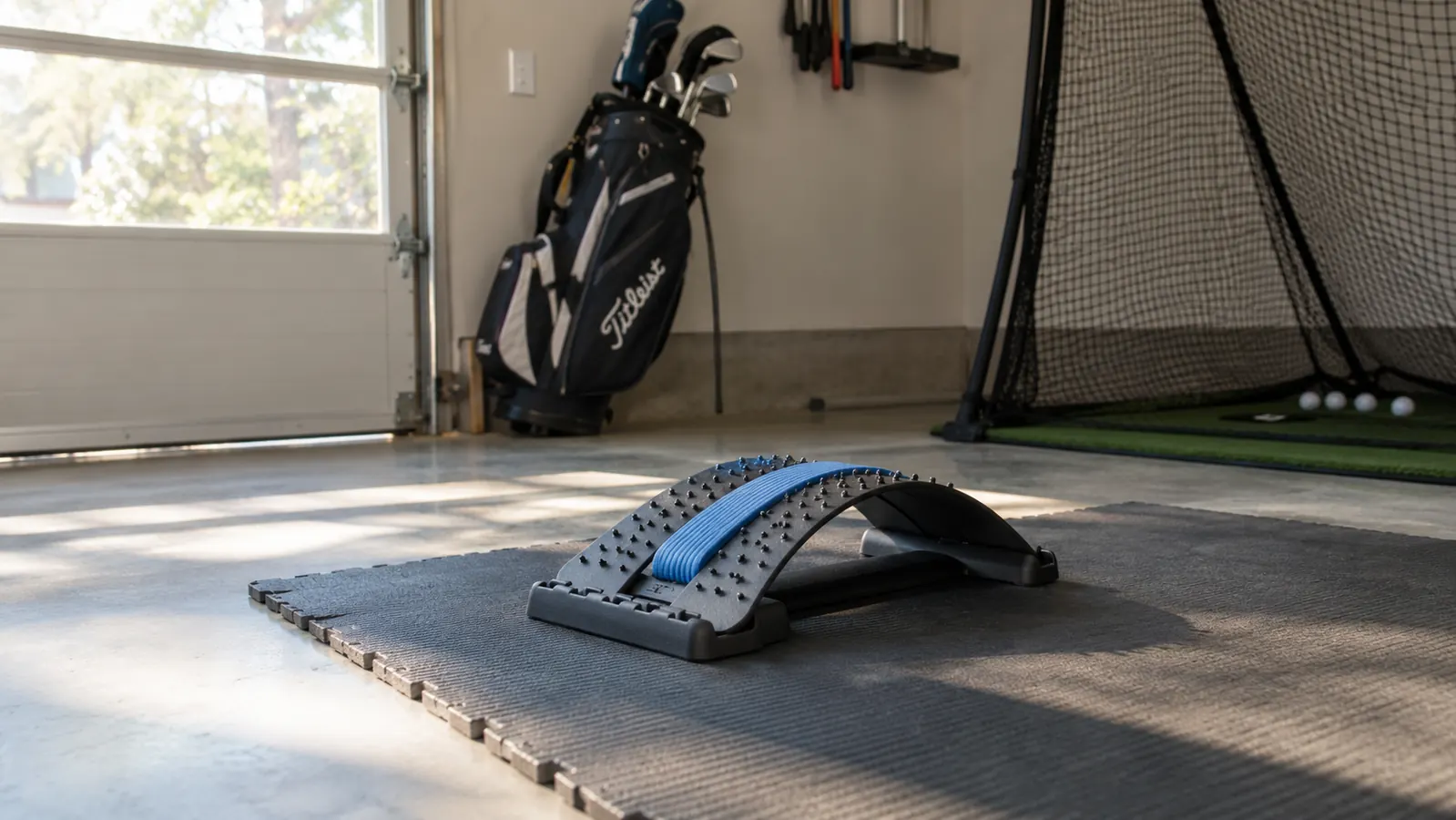
My lower back keeps a schedule that has nothing to do with my calendar. It behaves on the first tee, starts complaining somewhere around the turn, and by the 15th hole it is tight enough that I am protecting it instead of swinging. I have lived with a stiff, achy lumbar spine for the better part of ten years, and I have tried a lot of remedies in that time. A foam roller has lived in my garage for most of it. Last spring I added the MINOLL Back Stretcher to the routine, and after a full season of using both, I have a clear answer to which one fits a golfer's back better.
The short answer is that they do different jobs, and a golfer with lower back tightness probably wants the MINOLL first and a foam roller second. The stretcher gives you a passive stretch you can hold for two or three minutes without thinking. The roller is an active tool that loosens your hips, glutes and upper back before you swing. I use both now, and I would not give up either one. If I could only keep one, it would be the MINOLL, because it targets the exact spot that ruins my back nine. But an honest comparison has to include the places where the foam roller wins, and I will get to those.
What Each One Actually Does
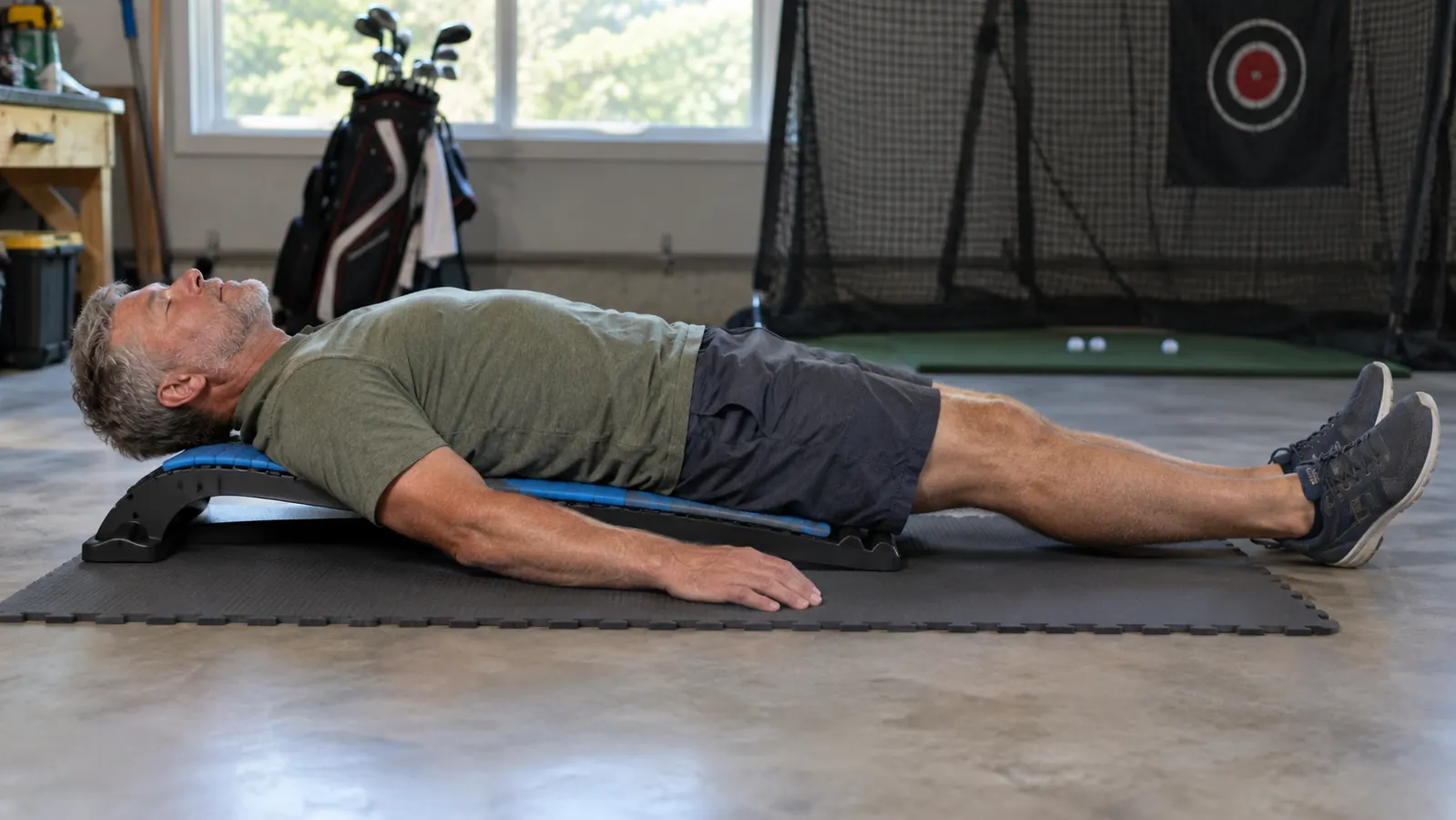
The MINOLL Back Stretcher is a simple idea. You lie down, slide it under your lower back, and let gravity do the work. You can start gentle and work up to a deeper stretch as your back loosens up. Once you are in position, you do not have to hold anything or balance. You just lie there. For me, that is the difference between actually stretching and skipping it, because I am not coordinated enough to hold a yoga pose and relax at the same time. The first time I used it, I was surprised how much pressure a few minutes of lying still could take off.
A foam roller is the opposite kind of tool. You are the engine. You roll your body weight over the cylinder, and the pressure works out tight spots in your muscles. It is excellent for your glutes, your hips, your upper back and your calves, which are all muscles a golfer leans on. It is also more work. You have to support yourself with your arms and legs, you have to find the sore spot, and you have to tolerate the discomfort long enough for it to do any good. Both tools have a place in a golfer's routine. They just sit at different points in the day.
How I Compared Them Over a Season
I tested both the way I test most things: in the garage and on the course, from May through October. The garage has a foam mat, a hitting net and a bucket of range balls, so I can hit a dozen wedges and then stretch without going inside. On course days I used the foam roller before I left the house, and the MINOLL after the round. On range days I used the MINOLL when I got home. I kept the routine simple on purpose. I did not want a system that required a spreadsheet, because I would not stick with it.
One detail worth knowing: I am 62, and I walk with a push cart when my back allows. That means my lower back carries a full round of standing, reaching and twisting. By the back nine it is tired before I even swing. The roller helped me start the round looser. The MINOLL helped me recover after it. Over a season, the recovery piece made the bigger difference in how I felt the next morning, which is when I pay for a long day on the course.
| MINOLL Back Stretcher | Foam Roller | |
|---|---|---|
| Best for | Targeted lower back stretching you can hold for minutes | Whole-body muscle work before a round |
| How it works | You lie still on the arch and let gravity stretch your lumbar spine | You move your body weight over the roller to massage tissue |
| Ease of use | Position it, lie back, relax. No balancing act | You support your own weight, which takes practice |
| Pre-round warm-up | Better as a post-round or rest-day stretch | Better at waking up tight muscles before you swing |
| Versatility | One job, done well | Hips, glutes, thoracic spine, calves, quads |
| Portability | Compact, fits in the trunk without a thought | Full-size rollers take up real room |
| Cost to start | One-time purchase, nothing to replace | Usually the cheaper way to begin |
Where the MINOLL Back Stretcher Wins
The MINOLL wins the category that matters most to a golfer like me: it targets the lower back, and it does not ask anything of you while it works. My lumbar spine tightens from standing over putts and from the rotation of the swing, especially late in a round. With the foam roller, I have to hunt for the right angle and hold myself up while I do it. With the MINOLL, I get on the floor, slide it into place, and within a minute I can feel the muscles along my spine let go. I have dozed off on it more than once after a long day at the course.
It also wins on consistency. Because the stretch is built into the device, I get the same stretch every time. I do not have to remember proper form or rewatch a video. I started gentle and worked up as the season went on. My wife Linda has used it too, after she walks nine holes with me on summer evenings, and she noticed the same thing: you cannot really do it wrong. For a guy in his sixties who does not bend like he used to, that counts for a lot.
Where a Foam Roller Wins
The foam roller wins the warm-up, and the warm-up matters. If I roll my hips, glutes and upper back for ten minutes before I leave for the course, I feel it in my swing by the third hole. The MINOLL is a stretch, and stretching cold muscles has never done much for me. Rolling gets blood moving and finds the knots that a passive stretch will not touch. On days when my back is especially cranky, the roller is the first thing I reach for, and the MINOLL comes after.
The roller also wins on versatility and on the cost of getting started. One roller covers your hips, hamstrings, calves, thoracic spine and glutes. The MINOLL does one thing, and it does it well, but it is one thing. If you are not sure your back problem is really a muscle problem, a basic foam roller is the lower-cost way to find out. I would not tell a younger golfer to buy a back stretcher before they have owned a roller and used it. The roller teaches you where you are tight. The MINOLL fixes the one spot the roller cannot reach well.
The Stretch That Holds Up on the Back Nine
If your lower back tightens up mid-round the way mine does, the MINOLL Back Stretcher is what I reach for after golf. Same stretch every time, no balancing act, no technique to learn. It lives next to my hitting net for a reason.
Amazon Check Today's Price on Amazon →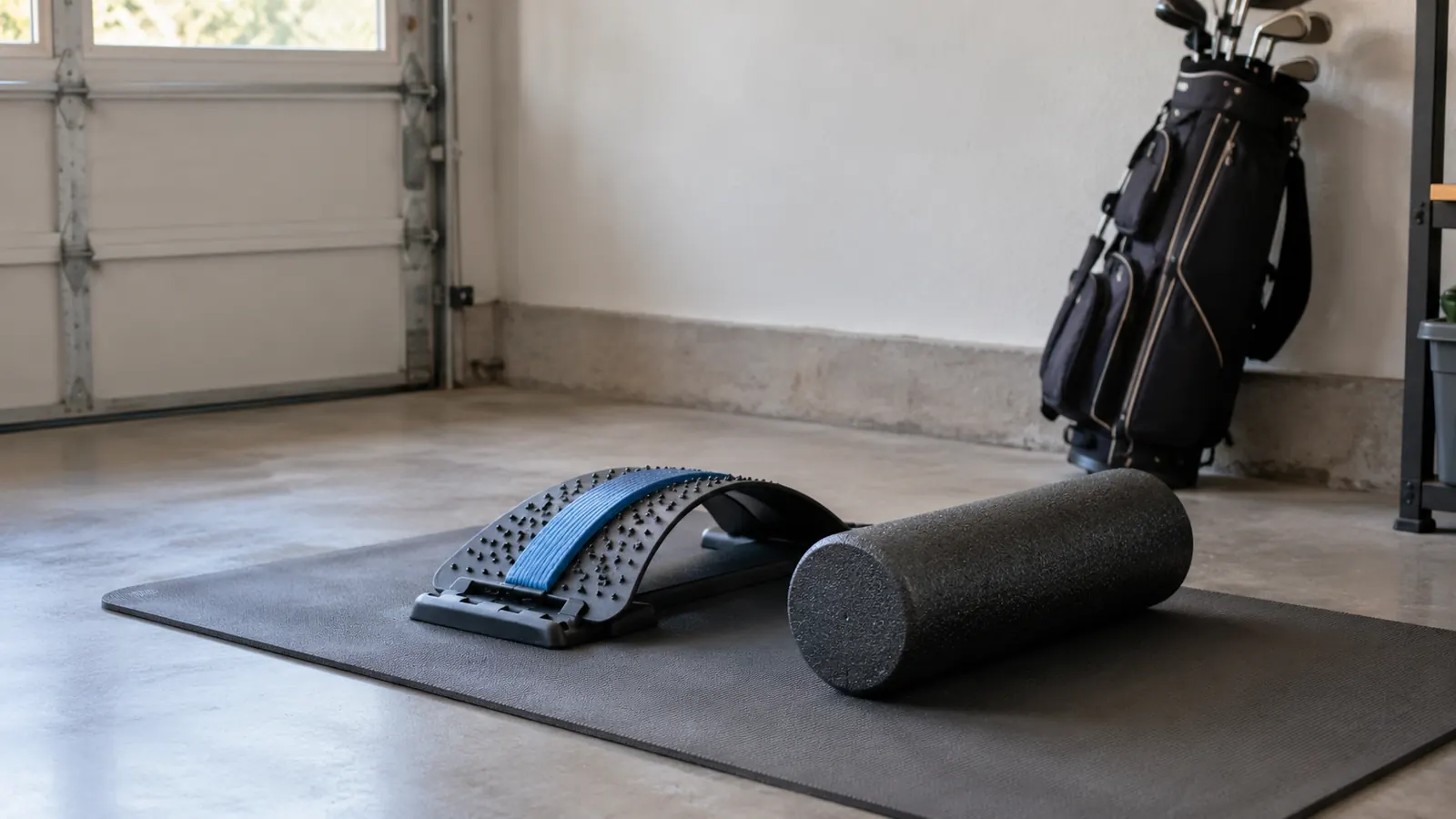
How I Use Both Without Overthinking It
Here is my routine, in case it helps. The night before a round, I spend ten minutes on the foam roller, mostly hips and glutes. The morning of the round, I do a lighter version, just enough to wake everything up. After the round, when my back is tired and tight, I lie on the MINOLL for three or four minutes. If I hit a bucket of range balls, I do the same thing when I get home. That is the whole system. It is not complicated, and it does not require me to be flexible or disciplined in any impressive way.
Birdie, our yellow Lab puppy, usually wanders over to see what I am doing, which is not as relaxing as it sounds. She has also decided the foam roller is a chew toy, so it now lives on a high shelf. The MINOLL stays on the mat because it is less interesting to a puppy, and that is one more point in its favor in this house. Rochester winters mean I use the garage net from November through April, so both tools get year-round work even when the course is under snow.
The One Thing That Surprised Me
I expected the roller to be the clear winner, because it does so much more. What surprised me was how often I reached for the MINOLL instead. The reason is simple: it is easier. On a day when my back is sore, the last thing I want to do is support my own weight on a cylinder and grind through the sore spots. Lying down and letting the stretch happen takes almost no effort, which means I actually do it. The best tool is the one you will use on the days you need it most, and for me that turned out to be the stretcher.
I will add one honest note here, the same one I give my friends. Neither tool fixes a back that needs medical attention. If your pain is sharp, or it radiates down your leg, or your foot goes numb, do not buy a stretcher and hope for the best. See a doctor or a physical therapist. I am a retired high school shop teacher, not a clinician. What I can tell you is what worked for a stiff, achy lower back after thirty years of golf, and that is a different problem than an injury.
Who Should Buy Which
Buy the MINOLL Back Stretcher if your complaint is the classic golfer's lower back: tight, achy, worse on the back nine, better after you stretch it. Buy it if you want a stretch you can hold without effort, if you have tried rolling and it never quite reaches the spot that bothers you, or if you are at an age where getting up and down off the floor is its own workout. It is also a good fit if you travel to courses, because it packs easier than a full-size roller.
Buy a foam roller instead if you are just starting out, if your tightness is spread across your hips and upper back, or if you want one tool that does a little of everything. Buy both if the budget allows, because they cover different parts of the day. And if you are not sure, start with the roller, because it is the lower-cost way to learn where you are actually tight. That is the order I would recommend to a friend, and it is the order I wish I had followed.
What I'd Tell a Friend Who Asked
If a buddy from the course asked me which to buy, I would say this: if you already own a foam roller and you still have lower back tightness after rounds, the MINOLL is the missing piece. If you own neither, start with the roller, learn where you are tight, and add the MINOLL when you know the roller is not reaching it. Most golfers I know end up with both. The roller gets them loose before the round, and the stretcher puts their back right afterward. They are not competing for the same job.
The one thing I would not do is buy a back stretcher expecting it to fix a serious back problem. It is a stretch, not a treatment. For a stiff, achy lower back from a lifetime of golf, it is the most useful stretch I have found. For anything sharp, radiating or numb, it is not the answer, and neither is a foam roller. That is the honest version, and it is the one I would give you in the parking lot.
One more thing, and it is worth repeating. The MINOLL is not a substitute for warming up, and the foam roller is not a substitute for cooling down. They work together. If you only have room in the budget for one, buy the one that matches your biggest complaint. Mine is the lower back after golf, so the MINOLL came first for me. Yours might be different, and that is fine.
Give Your Lower Back the Same Stretch Every Time
The MINOLL Back Stretcher is the one I keep on the garage mat, right next to the hitting net. If your back tightens up the way mine does, it is worth a look.
Amazon Check Today's Price on Amazon →