
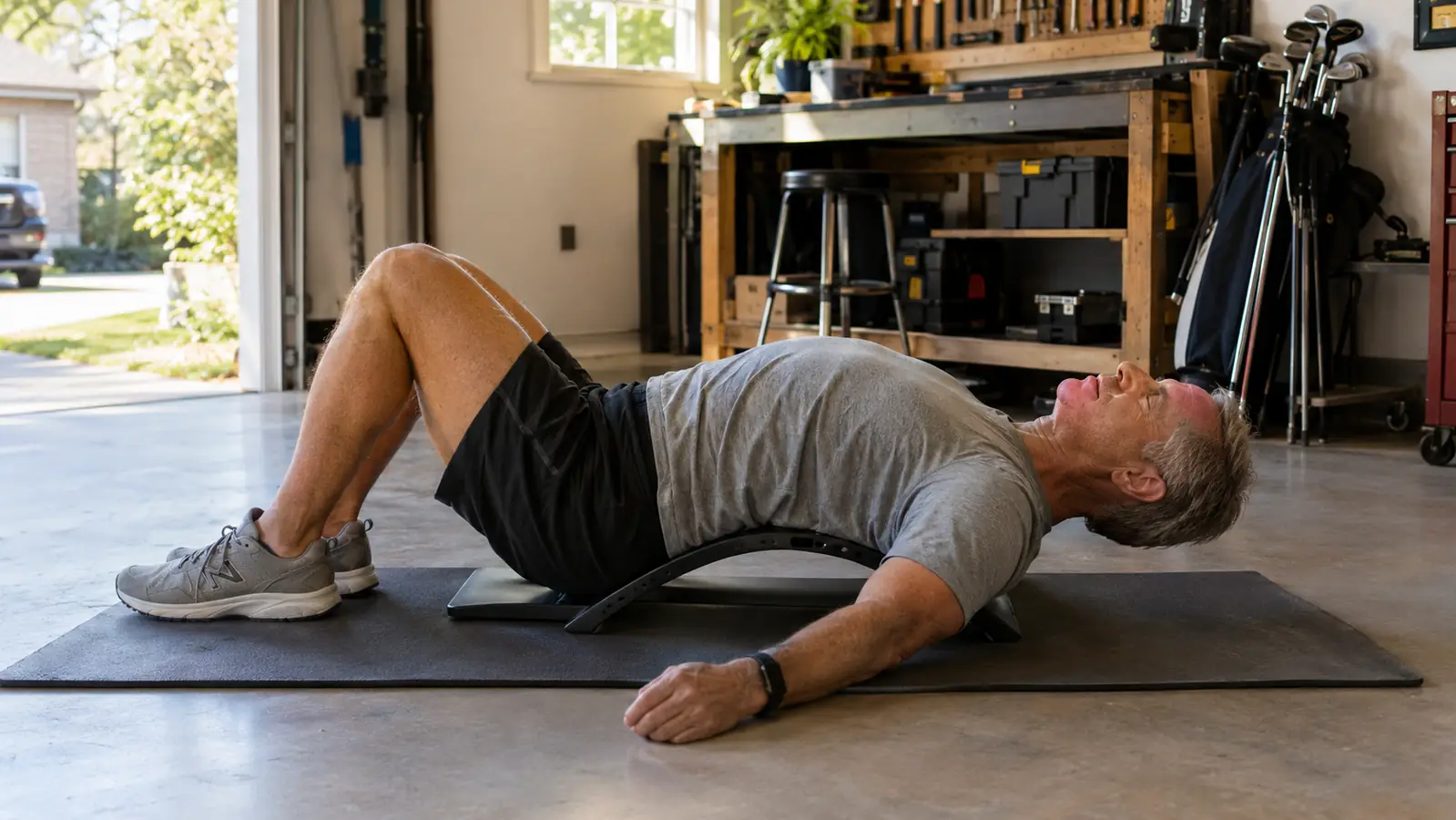
My lower back has been the least reliable part of my golf game for the last ten years. I am Gary Lindquist, 62, a retired shop teacher from Rochester, Minnesota, and I play about twice a week from May through October. The pattern is always the same: the first few holes feel fine, the back nine tightens up, and the day after a range session I move like I spent the night in a cheap motel bed. I have tried heat pads, icy hot rubs, a foam roller, and a lot of careful bending over to pick up tees. What I had not tried was a curved plastic stretcher that lets me lie on my back and let gravity do the work. So when the MINOLL back stretcher showed up, I decided to use it properly for a full season instead of writing a first-impression review after one week.
This is that review. It covers six months of near-daily use, what changed, what did not, and exactly who should think twice before buying one. I am not a doctor or a physical therapist, and nothing here replaces advice from one. If your back pain is sharp, radiates down a leg, or comes with numbness, put the phone down and call a professional.
The Quick Verdict
The MINOLL back stretcher is the first recovery tool that actually made it into my daily routine. It is not a cure for a bad back, but it reliably loosens a tight lumbar spine before a round and calms it down after one.
Amazon Check Today's Price →Loosen Up Before Your Next Round
Two minutes on the MINOLL back stretcher before you leave the house can mean the difference between a comfortable back nine and a stiff ride home. See today's price on Amazon and decide for yourself.
Amazon Check Today's Price on Amazon →How I've Used It
I started on the first Saturday in May, the same morning the course here finally dried out enough for carts. My routine was simple: ten minutes in the morning on the garage floor while I waited for my coffee to cool, and ten minutes after a round or a range session. Sometimes I used it while watching the news, sometimes while Birdie, our young yellow Lab puppy, decided my ankles were chew toys. My first attempt was a failure in the most instructive way. I laid the stretcher too high, with the arch under my shoulder blades instead of my lower back, and it felt like lying on a speed bump. I shifted it down until the arch sat right at my belt line, and the difference was immediate. The stretcher has a curved center that supports the lower back and a flat area for the head and tailbone. You lie on it with your knees bent, let your arms rest at your sides, and breathe. That is the whole instruction, and it is accurate. I set a timer on my phone after the first week because I kept losing track of time and lying there for twenty minutes.
For the first two weeks I kept waiting for the stretcher to feel like work. It never did. The sensation is more like a long, slow stretch that you do not have to hold yourself. The curve pushes gently into the lumbar area, and after a few minutes the muscles that have been guarding all day start to give up. I fell asleep on it twice in the first month, once with my coffee going cold on the workbench. Birdie woke me up the second time by licking my face, which is the closest she has come to approving of anything I do.
I used it on the foam mat I already had in the garage. The stretcher does not slide much on the mat, and it did not slide on the living room rug either. My wife Linda tried it twice and said it felt good on her lower back after she walked nine holes with me on summer evenings, though she never adopted it as a daily habit. Birdie, for the record, has no opinion and would prefer I spend that time throwing her ball.
What the MINOLL Back Stretcher Actually Does
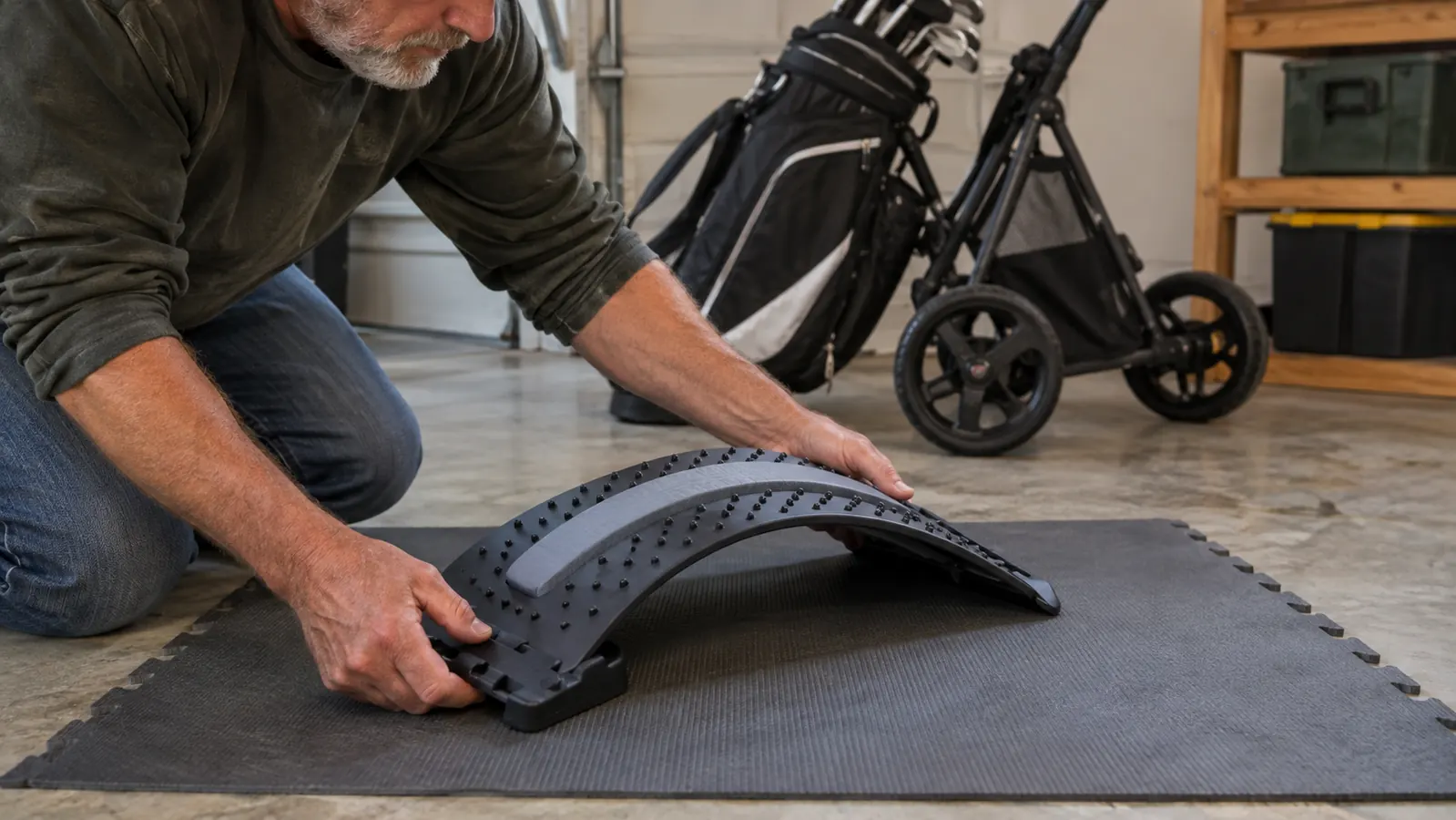
The MINOLL back stretcher is a curved board with a gentle arch. It is roughly the length of my forearm, and the arch rises a couple of inches at its highest point. You lie on it so the arch supports your lumbar spine, and your own body weight provides the stretch. There is no motor, no strap, no vibration, no app. It is about as simple as a piece of recovery equipment can be, and that simplicity is the point. The brand calls it a back stretcher for lower back pain relief, and the design is common enough that you have probably seen one in a friend's garage or in a physical therapy office. My first instinct was to treat it like a workout. I pushed my back hard into the arch and tried to hold a deep stretch, the way I would with a foam roller. That was wrong, and my back complained about it. The next session I just lay there and breathed, and the stretch found me instead of me finding it. That is the counterintuitive part of this tool: the less you do, the more it works.
What surprised me is how much of the benefit comes from just lying still. When your back is tight, the muscles around the spine are in a low-grade spasm. The arch of the stretcher encourages those muscles to lengthen and relax, the same way a good night's sleep does, only faster. It is not cracking anything and it is not forcing a range of motion. It is simply giving your lower back a position it cannot easily find on its own, and holding it there for a few minutes. The first few sessions I kept waiting for a pop or a release, the way you get from a chiropractor. That never came. What came instead was a slow, quiet loosening that I only noticed when I stood up.
The build quality is better than I expected for the price range. The surface is smooth, with no rough edges along the sides, and the curve has held its shape through six months of daily use. It does not feel flimsy when you put your full weight on it. I weigh around 200 pounds, and the stretcher has never creaked or flexed in a way that worried me. I have also left it leaning against the garage wall through a Minnesota summer and winter, and it has not warped or cracked. I cannot speak to how it holds up at 300 pounds, but at my size it has been solid.
How It Performed Through a Full Golf Season
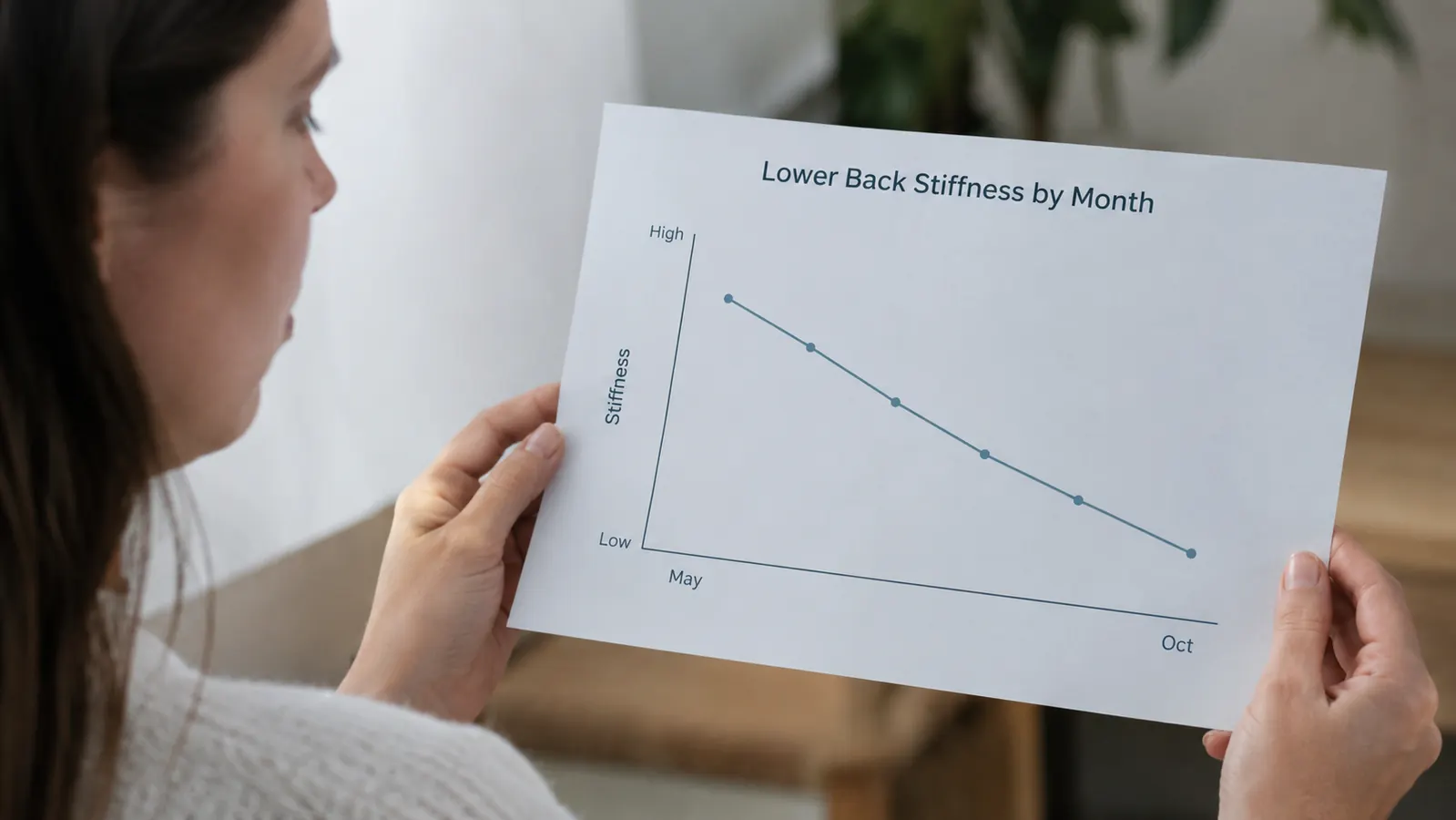
The honest headline is this: my back is not cured, but my golf season was better than it has been in years. The most noticeable change came on the course. Before, the back nine was a countdown until the stiffness arrived. This season, I walked the full 18 with a push cart more often than I have in a decade. I still had tight days, especially after long car rides to the course or after hitting a bucket of range balls, but the tightness showed up later and left sooner. The round that convinced me was a Saturday in late July. I had a 7:30 tee time, my back was stiff from a week of building a workbench in the shop, and I seriously considered calling to cancel. Instead I spent ten minutes on the MINOLL before I loaded the car, drove the twenty minutes to the course, and played 18 holes without a single moment where I had to stop between shots and stretch. That had not happened to me in years. It happened again in August, and again in September. Not every round, but often enough that I stopped being surprised by it.
The range session test was the most convincing. A typical practice day used to mean a stiff lower back that evening and a cautious first few holes the next morning. This season, I would come home, spend ten minutes on the MINOLL, and the evening stiffness was noticeably milder. One Wednesday in August I hit a large bucket of balls, then a small one, which is more than I normally do, and I paid for it on the drive home. Ten minutes on the stretcher that evening, and the worst of it was gone by dinner. It did not eliminate the stiffness. I want to be clear about that. What it did was shorten the recovery time from most of the evening to about an hour.
I also used it on the mornings of tournament days, and I believe it helped me start looser. I cannot prove that with a lab test, and I am not going to pretend I ran one. What I can tell you is that my warmup routine changed. I used to spend the first three holes feeling for my swing, taking practice swings between shots and hoping the stiffness would work itself out. Now I spend two minutes on the stretcher before I leave the house and I feel like I get those three holes back. That may not sound like much, but three holes is roughly a quarter of an hour of golf that used to be a write-off.
My back is not cured, but I walked the full 18 with a push cart more often this season than I have in a decade. That is the honest measure of what this thing did for me.
The Pros and Cons After Six Months
What I Liked
- Genuinely simple to use: lie down, bend your knees, breathe
- Provides a real, noticeable stretch without requiring effort
- Durable enough for daily use on a garage floor
- Light and easy to move from garage to living room
- Helped reduce evening stiffness after range sessions
- No batteries, no assembly, no learning curve
Where It Falls Short
- Not a cure for underlying back problems, and it should not be sold as one
- Takes a few sessions to find the right position and get comfortable
- The stretch can feel intense at first if your back is very tight
- Does not work for everyone; my wife liked it, my neighbor did not
- No instructions beyond the basics, so you have to experiment a little
Who This Is For
The MINOLL back stretcher is for the weekend golfer whose back is stiff, not injured. If you recognize the feeling of a lower back that tightens up on the back nine, complains after a long drive to the course, or reminds you about yesterday's range session, this is worth a try. It is also for people who have been told by a professional that gentle stretching would help, but who never actually stretch because it feels like homework. Lying on this thing for ten minutes is the easiest stretching habit I have ever kept. I have owned a foam roller for fifteen years and used it maybe a dozen times. It takes balance, effort, and a floor position that makes my knees complain. The MINOLL requires none of that. You lie down, and the stretch happens. That is the entire reason it became a habit and the roller did not. One of the guys in my regular foursome borrowed mine for a week in August after complaining about his own back on the 14th tee. He ordered his own before September. That is the strongest endorsement I can offer: he tested it in my garage and then paid for one himself.
It is especially good for golfers because it takes almost no time and no warmup. You can use it in the garage before you load the car, and you can use it again when you get home. It fits easily on a shelf or against a wall, and it does not look like medical equipment. That sounds like a small thing, but it meant I left it out in the garage instead of burying it in a closet, and leaving it out is why I actually used it. The foam roller lives behind the water heater for the same reason I never used it: it looked like work every time I saw it. The MINOLL looks like a place to rest, so I used it like one.
Who Should Skip It
Skip the MINOLL back stretcher if your back pain is sharp, shooting, or accompanied by numbness or tingling. No piece of curved plastic is the right answer for a nerve problem, and stretching the wrong way can make things worse. See a doctor or a physical therapist first. I mean that sincerely, not as a disclaimer. I spent ten years treating a stiff back with self-diagnosis, and the only reason I am comfortable recommending this stretcher is that my issue was muscular tightness, not something more serious.
Skip it also if you are looking for a dramatic fix. The MINOLL back stretcher will not fix a bad swing, a weak core, or a decade of sitting at a desk. It is a tool for managing stiffness, not a cure for a back condition. My neighbor tried it once, said it felt like lying on a rolled-up rug, and went back to his foam roller. That is a fair take. The stretcher is not magic, and anyone who tells you otherwise is selling something. It also will not do anything for the kind of back that hurts when you first wake up and never quite loosens through the day. Mine is the stiff kind that responds to heat and movement. If yours is the other kind, the one that hurts no matter what you do, spend the money on a professional opinion instead.
Give Your Back the Same Chance I Did
You do not need another gadget that ends up in a closet. You need a simple tool you will actually use. The MINOLL back stretcher earned its place in my garage. See today's price on Amazon.
Amazon Check Today's Price on Amazon →